


 साझा अर्थ संवाददाता
१८ असार २०८३, बिहिवार
साझा अर्थ संवाददाता
१८ असार २०८३, बिहिवार
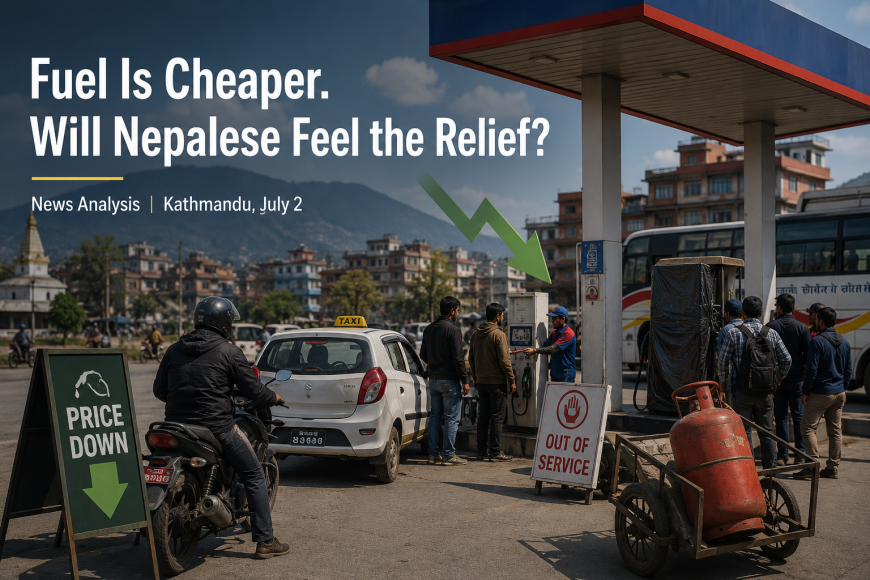
Kathmandu, July 2 — Nepal’s July 1 fuel price rollback has brought welcome relief on paper, but the confusion that followed at petrol pumps has raised a larger question: will ordinary consumers actually feel the benefit?
Nepal Oil Corporation reduced petrol prices by Rs 20 per litre, diesel and kerosene by Rs 30 per litre, domestic aviation fuel by Rs 40 per litre, and LPG by Rs 100 per cylinder. The rollback followed easing global oil prices and lower supply costs from Indian Oil Corporation, Nepal’s sole fuel supplier. Reuters reported that Nepal reduced fuel prices by up to 17 percent as global prices eased after progress toward ending the Iran war reduced fears of supply disruption.
For many households across Nepal, the price cut comes at a time when daily expenses remain under pressure. Fuel is not merely another commodity. Its price affects how people travel, how goods are transported, how businesses operate, and how families manage their kitchen budgets.
Petrol directly affects motorcycles, taxis, private vehicles and small businesses. Diesel influences public transport, freight movement, construction, agriculture and the broader cost of moving goods across the country. LPG is tied directly to household cooking expenses. Aviation fuel, meanwhile, affects domestic air travel, which remains important in a country where geography often makes road travel difficult and time-consuming.
That is why a fuel rollback of this scale carries expectations beyond the pump. Consumers do not only expect cheaper petrol or diesel. They expect fairer transport costs, reduced pressure on airfares, lower freight expenses and some relief in household expenditure.
The July 1 rollback is not merely a routine price adjustment. It is a test of Nepal’s price pass-through system.
The central question is simple: when global oil prices fall and NOC reduces domestic prices, how quickly does that relief reach ordinary consumers?
There were early signs that some benefits were beginning to move through the system. Lower domestic aviation fuel prices created room for airfare adjustments. At the same time, transport entrepreneurs urged the government to revise public transport fares in line with the lower petrol and diesel prices under the automated fare adjustment system.
This matters because consumers often feel fuel-price increases quickly. When prices rise, transport fares, delivery costs and the prices of goods tend to move upward without much delay. When prices fall, the public naturally expects the same speed in reverse.
If airlines adjust fares but public transport fares remain unchanged, or if freight costs do not ease despite lower diesel prices, the benefit of the rollback becomes uneven. A price cut by NOC is only the first step. Real relief depends on how responsibly and quickly other sectors respond.
The most visible disruption came from petrol pumps. Soon after the price cut, some private fuel stations were reported to have stopped sales or displayed signs indicating that fuel was unavailable. For consumers, this created frustration and suspicion.
When prices fall sharply and pumps stop selling, people naturally wonder whether dealers are trying to avoid losses, delay sales or create an artificial shortage. Such concerns are serious because fuel is an essential commodity. Even a short disruption can affect commuters, businesses and public confidence.
NOC responded by mobilizing monitoring teams and taking action against stations suspected of irregularities. Nepal News reported that the corporation later removed locks placed on 14 petrol pumps—eight in Kathmandu and six in Pokhara—after the fuel supply issue was resolved and the pumps resumed operations.
This detail is important. The pump episode should not be reduced to a simple accusation against dealers. If some stations genuinely had no fuel in stock, then the problem was not only misconduct. It also reflected a coordination failure in the supply chain.
A major price cut changes incentives quickly. Dealers may hesitate to lift fuel before or after a price revision. Existing stocks may run out. Consumers may rush to buy after prices fall. Regulators may act under public pressure. Without clear communication and proper stock planning, even a positive price decision can create disorder.
This is what the July 1 rollback exposed. Nepal may be able to revise prices in response to global market changes, but the system still struggles to ensure smooth delivery at the consumer level.
Price changes should not leave consumers guessing whether pumps will open, whether transport fares will be revised, or whether supply will remain stable. In a sensitive market such as fuel, uncertainty can quickly turn into panic, suspicion and public frustration.
Nepal’s automatic pricing mechanism is designed to adjust domestic fuel prices in line with international prices and supplier costs. But the latest episode shows that automatic pricing alone is not enough.
What Nepal needs is automatic relief.
Automatic relief means that when fuel prices fall, consumers should feel the benefit through actual access to fuel, timely transport fare adjustments, fair airfare reductions, lower freight pressure and more predictable household expenses.
For this to happen, stronger coordination is needed among NOC, fuel dealers, transport regulators, airlines, local authorities and consumer protection bodies. Dealers should have clear stock-reporting obligations before and after major price changes. Monitoring should be firm enough to prevent artificial shortages, but fair enough to distinguish between deliberate hoarding and genuine lack of supply.
Transport fare adjustment mechanisms should also be transparent and timely. If fuel-price increases can trigger swift demands for fare revisions, then fuel-price reductions should trigger the same urgency in favour of consumers.
The July 1 rollback is both welcome news and a reminder of Nepal’s structural weakness. It shows that global price relief can reach Nepal, but it also shows that the path from international oil markets to ordinary households is not always smooth.
As a fuel-importing country, Nepal cannot control global oil prices, geopolitical tensions or the supply rates set by external suppliers. But it can control how transparently domestic prices are adjusted, how fairly fuel is distributed and how quickly savings are passed on to consumers.
For ordinary consumers, the expectation is simple and reasonable: cheaper fuel should mean real relief. It should reduce pressure on household budgets, make transport costs fairer, lower some business expenses and help ease inflationary expectations.
If the system works well, a fall in global oil prices can become meaningful domestic relief. If the system fails, even a welcome rollback can produce confusion, suspicion and distrust.
Nepal’s fuel prices have fallen. Now the more important test begins: whether Nepalese consumers actually feel the difference.







-thumb_840_560.jpg)